
Our Calendar

Person-Centered Care for Addiction: Compassionate Interventions for Effective Recovery Support
Person-Centered Care is a philosophy and set of strategies that seeks to minimize harm associated with high-risk behaviors while supporting positive, incremental behavior change. This approach believes all people are capable of change and will do so when they are ready and when circumstances allow. It uses compassion, dignity, respect, and consistent positive regard to promote healing and long-term recovery. This training will include a review of the basic principles and practices of person-centered care for addiction, an overview of why it works, sample person-centered strategies, and interactive activities to enhance learning.
Learning Objectives:
Identify the core tenets of the person-centered approach
Explain why a person-centered approach for addiction works to increase recovery outcomes
Describe high-risk behaviors and corresponding person-centered strategies
Explain how motivational conversations play a key role in the person-centered approach
Training offered by CODAC, in person

Role of Peers for the Behavioral Health Workforce: 2026 Recordings
Join this course to watch our pre-recorded webinars on important topics related to integrating peers in the behavioral health workforce.
Recording 1: Hiring and Retaining Peers
If you’re new to hiring peers it can be daunting to figure out all of the ins and outs. What does a job description for peer workers look like? How do you interview for the role and who should be on the interview team? This workshop will cover all those questions and more!
Recording 2: Peers are Hired, Now What?
After learning about hiring and retaining peers, it’s time to dive into building out a program where peers succeed and thrive as service providers! This workshop will cover the nitty gritty pieces of successful peer programming, from including peers in decision making to the difference between peer writing for Medicaid billing and clinical writing.
Recording 3: Peers + Clinicians: Where the Magic Happens
When bringing peers onto a team, you will need to prepare for a new team dynamic! Some team members may have never had the chance to work with peers before and may need some assistance in figuring out how to make the magic happen.

Motivational Interviewing and the Neuroscience of Stress
Stress is often perceived as solely an emotional experience, but decades of research demonstrate its impact on physical health and wellbeing. We will explore the neuroscience explaining how stress manifests in humans and how, through intentional use of MI skills, we can help the people we work with mitigate stress at the psychological, physical and epigenetic level.
Many MI skills and tools naturally lead to stress reduction. MI is based on the principle of meeting people as equals and experts on their own lives, with a desire to empower them. This approach eliminates the need for power struggles that can exacerbate environmental stressors. MI is also highly relational, activating pro-social areas of the brain. An MI exploration of intrinsic motivation highlights personal values, which can lead to organic changes in perspective and subsequent actions.
The highly interactive format of this course will increase your ability to work intentionally with MI Spirit and specific MI skills to quickly de-escalate situations, build collaborative partnerships and set achievable next steps.
A working knowledge of MI Spirit, OARS skills, and Change Talk are prerequisites for this class.
Objectives:
Review MI Spirit and OARS skills, with a focus on reflective listening
Explore the science of stress as a mind-body experience with common health impacts
Discover the elements that make MI an interpersonal stress management approach
Learn how to use MI to de-escalate interactions and build partnership
Practice real-world scenarios from your scope of practice
Course is offered in person at CODAC

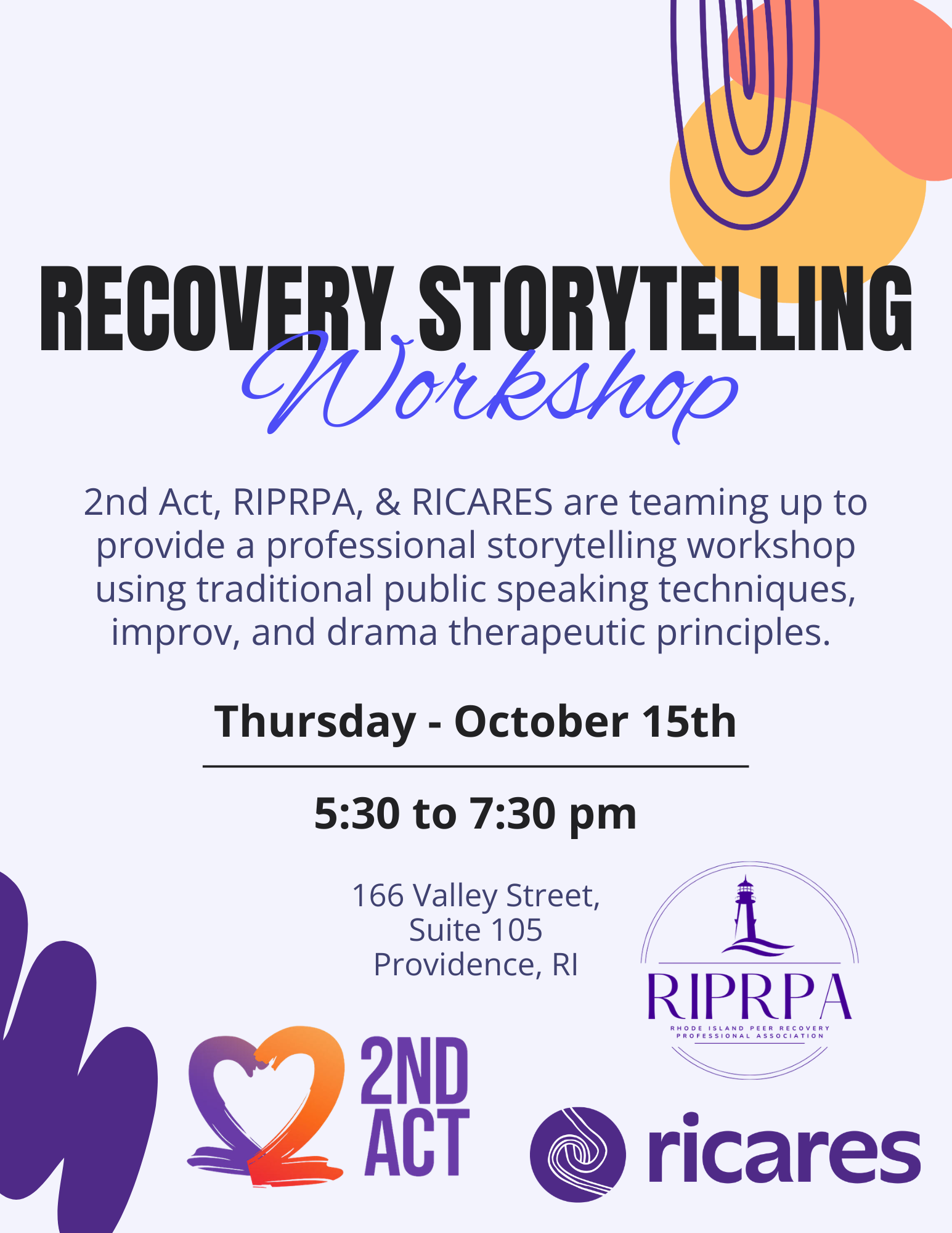

Role of Peers for the Behavioral Health Workforce: 2026 Recordings
Join this course to watch our pre-recorded webinars on important topics related to integrating peers in the behavioral health workforce.
Recording 1: Hiring and Retaining Peers
If you’re new to hiring peers it can be daunting to figure out all of the ins and outs. What does a job description for peer workers look like? How do you interview for the role and who should be on the interview team? This workshop will cover all those questions and more!
Recording 2: Peers are Hired, Now What?
After learning about hiring and retaining peers, it’s time to dive into building out a program where peers succeed and thrive as service providers! This workshop will cover the nitty gritty pieces of successful peer programming, from including peers in decision making to the difference between peer writing for Medicaid billing and clinical writing.
Recording 3: Peers + Clinicians: Where the Magic Happens
When bringing peers onto a team, you will need to prepare for a new team dynamic! Some team members may have never had the chance to work with peers before and may need some assistance in figuring out how to make the magic happen.

Role of Peers for the Behavioral Health Workforce: 2026 Recordings
Join this course to watch our pre-recorded webinars on important topics related to integrating peers in the behavioral health workforce.
Recording 1: Hiring and Retaining Peers
If you’re new to hiring peers it can be daunting to figure out all of the ins and outs. What does a job description for peer workers look like? How do you interview for the role and who should be on the interview team? This workshop will cover all those questions and more!
Recording 2: Peers are Hired, Now What?
After learning about hiring and retaining peers, it’s time to dive into building out a program where peers succeed and thrive as service providers! This workshop will cover the nitty gritty pieces of successful peer programming, from including peers in decision making to the difference between peer writing for Medicaid billing and clinical writing.
Recording 3: Peers + Clinicians: Where the Magic Happens
When bringing peers onto a team, you will need to prepare for a new team dynamic! Some team members may have never had the chance to work with peers before and may need some assistance in figuring out how to make the magic happen.

Substance Free Community Halloween
Join RICARES for a witchy, spooky, judgment-free Halloween party built for our community.
Whether you're 0 days in or 30 years strong, this night is for every version of you. Come in costume, come in jeans, just as you are.
Costumes optional. Community required.

Role of Peers for the Behavioral Health Workforce: 2026 Recordings
Join this course to watch our pre-recorded webinars on important topics related to integrating peers in the behavioral health workforce.
Recording 1: Hiring and Retaining Peers
If you’re new to hiring peers it can be daunting to figure out all of the ins and outs. What does a job description for peer workers look like? How do you interview for the role and who should be on the interview team? This workshop will cover all those questions and more!
Recording 2: Peers are Hired, Now What?
After learning about hiring and retaining peers, it’s time to dive into building out a program where peers succeed and thrive as service providers! This workshop will cover the nitty gritty pieces of successful peer programming, from including peers in decision making to the difference between peer writing for Medicaid billing and clinical writing.
Recording 3: Peers + Clinicians: Where the Magic Happens
When bringing peers onto a team, you will need to prepare for a new team dynamic! Some team members may have never had the chance to work with peers before and may need some assistance in figuring out how to make the magic happen.

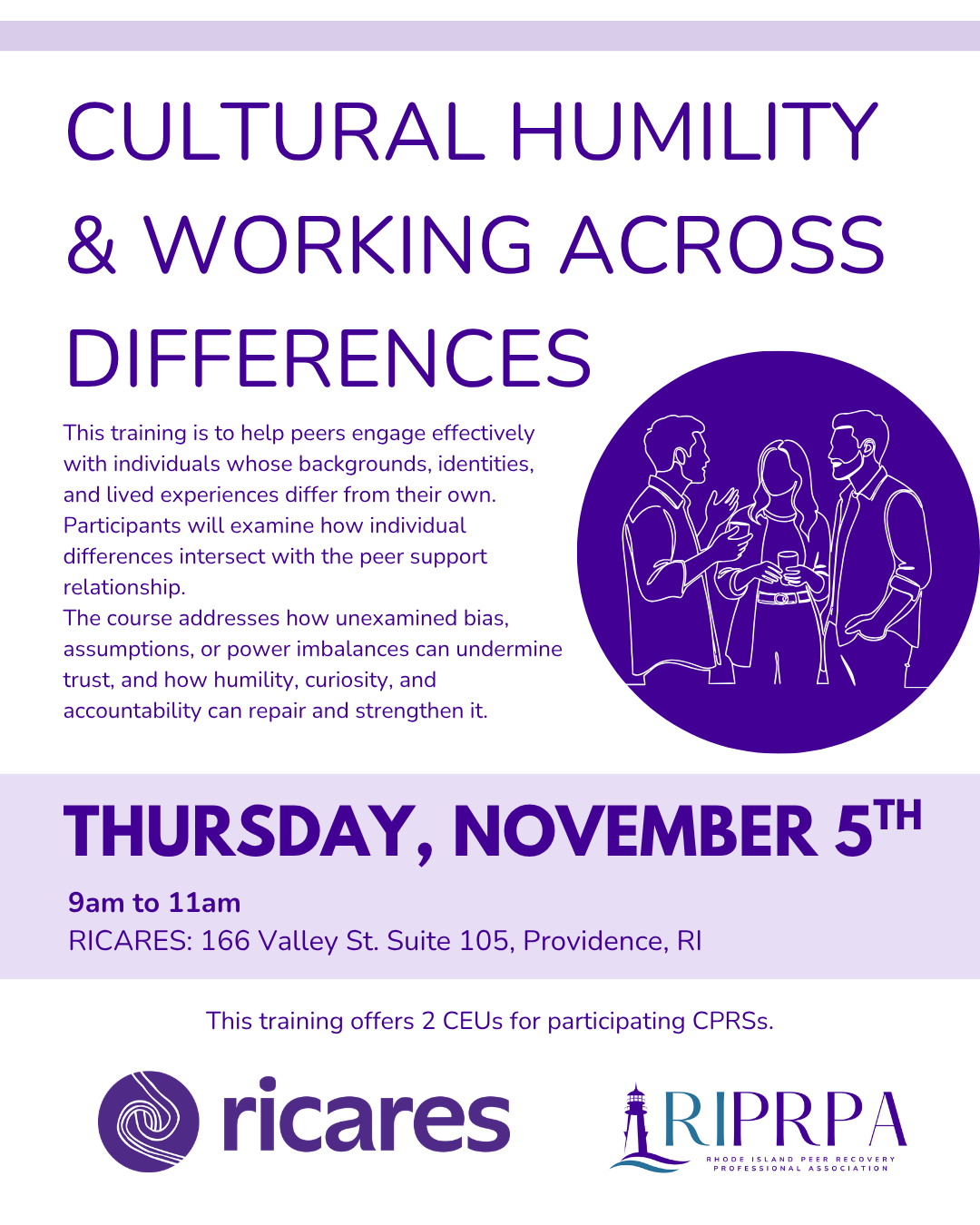
Cultural Humility Training (Rescheduled)
Cultural Humility and Working Across Differences for Peer Recovery Specialists.
Earn 2 CEUS toward your CPRS recertification

Role of Peers for the Behavioral Health Workforce: 2026 Recordings
Join this course to watch our pre-recorded webinars on important topics related to integrating peers in the behavioral health workforce.
Recording 1: Hiring and Retaining Peers
If you’re new to hiring peers it can be daunting to figure out all of the ins and outs. What does a job description for peer workers look like? How do you interview for the role and who should be on the interview team? This workshop will cover all those questions and more!
Recording 2: Peers are Hired, Now What?
After learning about hiring and retaining peers, it’s time to dive into building out a program where peers succeed and thrive as service providers! This workshop will cover the nitty gritty pieces of successful peer programming, from including peers in decision making to the difference between peer writing for Medicaid billing and clinical writing.
Recording 3: Peers + Clinicians: Where the Magic Happens
When bringing peers onto a team, you will need to prepare for a new team dynamic! Some team members may have never had the chance to work with peers before and may need some assistance in figuring out how to make the magic happen.

Role of Peers for the Behavioral Health Workforce: 2026 Recordings
Join this course to watch our pre-recorded webinars on important topics related to integrating peers in the behavioral health workforce.
Recording 1: Hiring and Retaining Peers
If you’re new to hiring peers it can be daunting to figure out all of the ins and outs. What does a job description for peer workers look like? How do you interview for the role and who should be on the interview team? This workshop will cover all those questions and more!
Recording 2: Peers are Hired, Now What?
After learning about hiring and retaining peers, it’s time to dive into building out a program where peers succeed and thrive as service providers! This workshop will cover the nitty gritty pieces of successful peer programming, from including peers in decision making to the difference between peer writing for Medicaid billing and clinical writing.
Recording 3: Peers + Clinicians: Where the Magic Happens
When bringing peers onto a team, you will need to prepare for a new team dynamic! Some team members may have never had the chance to work with peers before and may need some assistance in figuring out how to make the magic happen.

Women in Recovery: Pathways to Healing and Empowerment
Online training offered by TrainED
$35

Role of Peers for the Behavioral Health Workforce: 2026 Recordings
Join this course to watch our pre-recorded webinars on important topics related to integrating peers in the behavioral health workforce.
Recording 1: Hiring and Retaining Peers
If you’re new to hiring peers, it can be daunting to figure out all of the ins and outs. What does a job description for peer workers look like? How do you interview for the role, and who should be on the interview team? This workshop will cover all those questions and more!
Recording 2: Peers are Hired, Now What?
After learning about hiring and retaining peers, it’s time to dive into building out a program where peers succeed and thrive as service providers! This workshop will cover the nitty-gritty pieces of successful peer programming, from including peers in decision-making to the difference between peer writing for Medicaid billing and clinical writing.
Recording 3: Peers + Clinicians: Where the Magic Happens
When bringing peers onto a team, you will need to prepare for a new team dynamic! Some team members may have never had the chance to work with peers before and may need some assistance in figuring out how to make the magic happen.

Role of Peers for the Behavioral Health Workforce: 2026 Recordings
Join this course to watch our pre-recorded webinars on important topics related to integrating peers in the behavioral health workforce.
Recording 1: Hiring and Retaining Peers
If you’re new to hiring peers it can be daunting to figure out all of the ins and outs. What does a job description for peer workers look like? How do you interview for the role and who should be on the interview team? This workshop will cover all those questions and more!
Recording 2: Peers are Hired, Now What?
After learning about hiring and retaining peers, it’s time to dive into building out a program where peers succeed and thrive as service providers! This workshop will cover the nitty gritty pieces of successful peer programming, from including peers in decision making to the difference between peer writing for Medicaid billing and clinical writing.
Recording 3: Peers + Clinicians: Where the Magic Happens
When bringing peers onto a team, you will need to prepare for a new team dynamic! Some team members may have never had the chance to work with peers before and may need some assistance in figuring out how to make the magic happen.

Role of Peers for the Behavioral Health Workforce: 2026 Recordings
Join this course to watch our pre-recorded webinars on important topics related to integrating peers in the behavioral health workforce.
Recording 1: Hiring and Retaining Peers
If you’re new to hiring peers, it can be daunting to figure out all of the ins and outs. What does a job description for peer workers look like? How do you interview for the role, and who should be on the interview team? This workshop will cover all those questions and more!
Recording 2: Peers are Hired, Now What?
After learning about hiring and retaining peers, it’s time to dive into building out a program where peers succeed and thrive as service providers! This workshop will cover the nitty-gritty pieces of successful peer programming, from including peers in decision-making to the difference between peer writing for Medicaid billing and clinical writing.
Recording 3: Peers + Clinicians: Where the Magic Happens
When bringing peers onto a team, you will need to prepare for a new team dynamic! Some team members may have never had the chance to work with peers before and may need some assistance in figuring out how to make the magic happen.

Role of Peers for the Behavioral Health Workforce: 2026 Recordings
Join this course to watch our pre-recorded webinars on important topics related to integrating peers in the behavioral health workforce.
Recording 1: Hiring and Retaining Peers
If you’re new to hiring peers it can be daunting to figure out all of the ins and outs. What does a job description for peer workers look like? How do you interview for the role and who should be on the interview team? This workshop will cover all those questions and more!
Recording 2: Peers are Hired, Now What?
After learning about hiring and retaining peers, it’s time to dive into building out a program where peers succeed and thrive as service providers! This workshop will cover the nitty gritty pieces of successful peer programming, from including peers in decision making to the difference between peer writing for Medicaid billing and clinical writing.
Recording 3: Peers + Clinicians: Where the Magic Happens
When bringing peers onto a team, you will need to prepare for a new team dynamic! Some team members may have never had the chance to work with peers before and may need some assistance

HIPAA/Ethics Training
This training provides a comprehensive overview of the Health Insurance Portability and Accountability Act (HIPAA) and the ethical standards in Rhode Island that guide professional practice for providers. Participants will learn how to protect privacy, maintain confidentiality, and navigate complex situations using ethical guidelines. Through real-world scenarios and interactive discussion, this training equips participants to make informed, ethical decisions that uphold both professional integrity and the rights of those they serve.
Learning Objectives:
Define key principles of HIPAA and professional ethics in RI
Describe the process for ethical decision making
Identify common threats to good ethical care in behavioral health
Identify and describe client rights
Apply HIPAA and ethical guidelines to real world case studies
This training is held in person at Amos House

Person-Centered Care for Addiction: Compassionate Interventions for Effective Recovery Support
Person-Centered Care is a philosophy and set of strategies that seeks to minimize harm associated with high-risk behaviors while supporting positive, incremental behavior change. This approach believes all people are capable of change and will do so when they are ready and when circumstances allow. It uses compassion, dignity, respect, and consistent positive regard to promote healing and long-term recovery. This training will include a review of the basic principles and practices of person-centered care for addiction, an overview of why it works, sample person-centered strategies, and interactive activities to enhance learning.
Learning Objectives:
Identify the core tenets of the person-centered approach
Explain why a person-centered approach for addiction works to increase recovery outcomes
Describe high-risk behaviors and corresponding person-centered strategies
Explain how motivational conversations play a key role in the person-centered approach
This training is offered virtually

Person-Centered Care for Addiction: Compassionate Interventions for Effective Recovery Support (Day 2)
Person-Centered Care is a philosophy and set of strategies that seeks to minimize harm associated with high-risk behaviors while supporting positive, incremental behavior change. This approach believes all people are capable of change and will do so when they are ready and when circumstances allow. It uses compassion, dignity, respect, and consistent positive regard to promote healing and long-term recovery. This training will include a review of the basic principles and practices of person-centered care for addiction, an overview of why it works, sample person-centered strategies, and interactive activities to enhance learning.
Learning Objectives:
Identify the core tenants of the person-centered approach
Explain why a person-centered approach for addiction works to increase recovery outcomes
Describe high-risk behaviors and corresponding person-centered strategies
Explain how motivational conversations play a key role in the person-centered approach
This training is offered virtually

Advanced Ethics for CPRS
This advanced ethics training is designed for experienced Peer Support Specialists to meet their biannual ethics training requirements. Building upon the CPRS training content, this training moves beyond basic “rules” and into the nuanced ethical decision-making that is required when working with vulnerable populations.
Participants will explore ethical gray areas that commonly arise in peer roles—including boundaries, dual relationships, power dynamics, self-disclosure, and confidentiality—through a trauma-informed, peer-led lens. Emphasis is placed on protecting the peer relationship and person served without sacrificing authenticity, mutuality, or any of the core values of peer support.
This training centers ethical practice as ongoing skill development, not a checklist that can be achieved. It promotes self-awareness, reflection, consultation, and a willingness to live in the gray in the face of ambiguity.
Learning Objectives
Describe all key components of the RICB Code of Ethical Conduct
Identify ethical gray areas and ways to navigate them effectively
Explain the importance of strong boundaries in peer support work and practices in effectively setting and keeping them
Describe the importance of supervision in both preventing and addressing ethical dilemmas
Identify the process for filing an ethics complaint and setting expectations for participation if warranted
Apply critical thinking skills and peer values to real life scenarios to promote learning and ability to handle ethical concerns as they arise in peer work

Motivational Interviewing I: Foundations, First Steps and Feeling Confident
When change is difficult, we need to deliberately communicate, connect and collaborate in effective ways. Motivational Interviewing (MI) offers an evidence-based, grounded approach to conversations about next steps, as well as a specific clinical skill set that create effective interventions. Focused on identifying and cultivating personal motivation, MI conversations are fertile ground where solutions arise and positive outcomes become more likely.
This highly interactive training covers the fundamentals of MI theory and then concentrates on the boots-on-the-ground skills that will make an immediate difference in your work. This is the appropriate class for beginners and for practitioners at any level who want to reexamine their skills and use them in a more confident and nuanced way.
Learning Objectives:
Explore the MI spirit and tasks
Practice 5 skills in the MI tool kit
Learn to identify Change Talk
Identify and avoid the Fixing Reflex
Encourage you to put MI into practice

Motivational Interviewing II: Rapid Engagement for Effective, Collaborative Change
Encouraging behavior change can be one of the most challenging and frustrating aspects of working with people in your environment. Motivational Interviewing (MI) offers the opportunity to communicate clearly, cultivate the desire for change and create personalized treatment plans that lead to results.
This training will teach specific MI clinical skills but is more than a toolkit. You will learn a grounded approach that, by focusing on Change Talk, stimulates rapid engagement, builds strong therapeutic relationships and promotes a sense of true collaboration. You will go home knowing how to free stuck people to imagine a new way of doing things, identify their next steps and effectively work toward beneficial outcomes.
Objectives:
Gain confidence creating rapid engagement in brief interventions
Learn 5 ways to harness the incredible power of reflections
Explore ways to both identify and create Change Talk
Generate client-centered goals by using The Why and Scaling Questions
Practice with peers to respond in real time to real-world situations

Motivational Interviewing and the Stages of Change Toolkit
We often hear the expression, "Meet people where they are", but what does that actually mean? How can we skillfully do this without losing sight of the forward growth and change that will lead them to their best life?
The Trans-theoretical Model, commonly known as the Stages of Change, describes the states humans find themselves in as they consider, make and maintain changes. Motivational Interviewing (MI) is a flexible communication tool kit that promotes connection, collaboration and mobilizes inner and outer resources. This highly interactive, intermediate-level training integrates the two, provides practice in identifying the Stage of Change as it shifts and offers a menu of practical MI skills to work effectively within each stage.
Objectives:
Introduce the Transtheoretical Model
Learn to use client language and behavior to identify Stages of Change
Review MI Spirit's role in creating impactful, supportive relationships
Practice stage-specific MI interventions
Prerequisites:
Previous MI training and/or working knowledge of MI Spirit, OARS skills, and Change Talk.

Motivational Interviewing I: Foundations, First Steps and Feeling Confident
When change is difficult, we need to deliberately communicate, connect and collaborate in effective ways. Motivational Interviewing (MI) offers an evidence-based, grounded approach to conversations about next steps, as well as a specific clinical skill set that create effective interventions. Focused on identifying and cultivating personal motivation, MI conversations are fertile ground where solutions arise and positive outcomes become more likely.
This highly interactive training covers the fundamentals of MI theory and then concentrates on the boots-on-the-ground skills that will make an immediate difference in your work. This is the appropriate class for beginners and for practitioners at any level who want to reexamine their skills and use them in a more confident and nuanced way.
Learning Objectives:
Explore the MI spirit and tasks
Practice 5 skills in the MI tool kit
Learn to identify Change Talk
Identify and avoid the Fixing Reflex
Encourage you to put MI into practice

Motivational Interviewing II: Rapid Engagement for Effective, Collaborative Change
Encouraging behavior change can be one of the most challenging and frustrating aspects of working with people in your environment. Motivational Interviewing (MI) offers the opportunity to communicate clearly, cultivate the desire for change and create personalized treatment plans that lead to results.
This training will teach specific MI clinical skills but is more than a toolkit. You will learn a grounded approach that, by focusing on Change Talk, stimulates rapid engagement, builds strong therapeutic relationships and promotes a sense of true collaboration. You will go home knowing how to free stuck people to imagine a new way of doing things, identify their next steps and effectively work toward beneficial outcomes.
Objectives:
Gain confidence creating rapid engagement in brief interventions
Learn 5 ways to harness the incredible power of reflections
Explore ways to both identify and create Change Talk
Generate client-centered goals by using The Why and Scaling Questions
Practice with peers to respond in real time to real-world situations

Motivational Interviewing and the Neuroscience of Stress
Stress is often perceived as solely an emotional experience, but decades of research demonstrate its impact on physical health and wellbeing. We will explore the neuroscience explaining how stress manifests in humans and how, through intentional use of Motivational Interviewing (MI) skills, we can help the people we work with mitigate stress at the psychological, physical and epigenetic level.
Many MI skills and tools naturally lead to stress reduction. MI is based on the principle of meeting people as equals and experts on their own lives, with a desire to empower them. This approach eliminates the need for power struggles that can exacerbate environmental stressors. MI is also highly relational, activating pro-social areas of the brain. An MI exploration of intrinsic motivation highlights personal values, which can lead to organic changes in perspective and subsequent actions.
The highly interactive format of this course will increase your ability to work intentionally with MI Spirit and specific MI skills to quickly de-escalate situations, build collaborative partnerships and set achievable next steps.
A working knowledge of MI Spirit, OARS skills, and Change Talk are prerequisites for this class.
Objectives:
Review MI Spirit and OARS skills, with a focus on reflective listening
Explore the science of stress as a mind-body experience with common health impacts
Discover the elements that make MI an interpersonal stress management approach
Learn how to use MI to de-escalate interactions and build partnership
Practice real-world scenarios from your scope of practice

Role of Peers for the Behavioral Health Workforce: 2026 Recordings
Join this course to watch our pre-recorded webinars on important topics related to integrating peers in the behavioral health workforce.
Recording 1: Hiring and Retaining Peers
If you’re new to hiring peers it can be daunting to figure out all of the ins and outs. What does a job description for peer workers look like? How do you interview for the role and who should be on the interview team? This workshop will cover all those questions and more!
Recording 2: Peers are Hired, Now What?
After learning about hiring and retaining peers, it’s time to dive into building out a program where peers succeed and thrive as service providers! This workshop will cover the nitty gritty pieces of successful peer programming, from including peers in decision making to the difference between peer writing for Medicaid billing and clinical writing.
Recording 3: Peers + Clinicians: Where the Magic Happens
When bringing peers onto a team, you will need to prepare for a new team dynamic! Some team members may have never had the chance to work with peers before and may need some assistance in figuring out how to make the magic happen.